Exploring Northeast Syrtis via Jezero Crater
NASA/JPL-Caltech/UArizona
Exploring Northeast Syrtis via Jezero Crater
ESP_054090_1985  Science Theme: Composition and Photometry
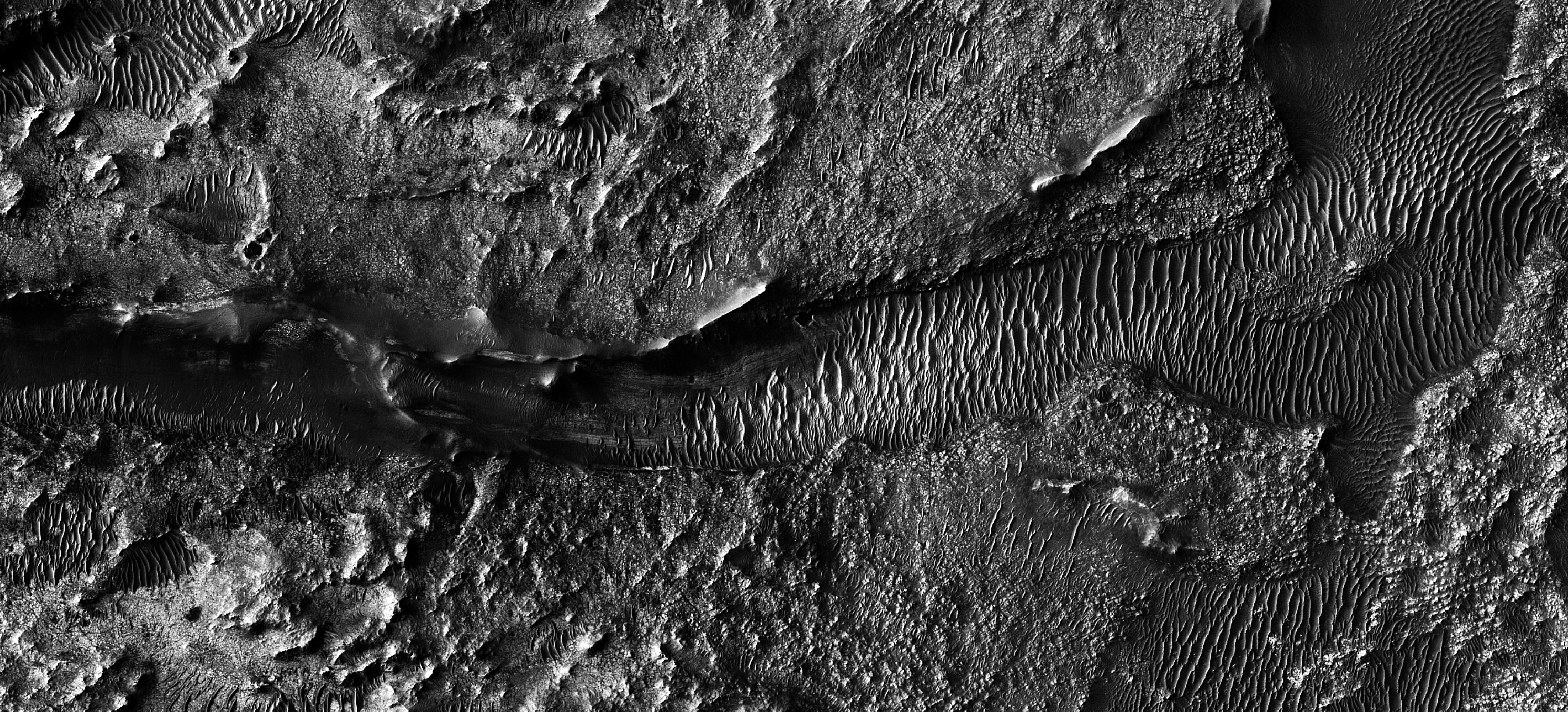
One of the final three candidate landing sites for the Mars 2020 mission was northeast Syrtis, along with Gusev Crater/Columbia Hills and the eventual landing site for the Perseverance rover, Jezero Crater. A key attraction of Syrtis was lithologic diversity spanning a broad interval of early Mars epochs in clear and readily accessible stratigraphic context throughout the landing ellipse.

Units of scientific interest include large, well-exposed blocks of megabreccia probably emplaced by the approximately 4 billion year-old Isidis impact, abundant clays and a high concentration of carbonates that could harbor evidence of past climate and of possible life (e.g. in an ancient, subsurface aquifer).

Fortunately, now that Perseverance has climbed to the rim of Jezero Crater, some elements of the envisioned northeast Syrtis landing site are starting to be explored by NASA. This cutout captures part of the ancient river channel that feeds into Jezero and created its iconic delta also studied by Perseverance to the east (See here for the rover’s location).


Written by: Matthew Chojnacki  (20 March 2026)

 
Acquisition date
09 February 2018

Local Mars time
15:07

Latitude (centered)
18.469°

Longitude (East)
77.103°

Spacecraft altitude
280.4 km (174.3 miles)

Original image scale range
29.0 cm/pixel (with 1 x 1 binning) so objects ~87 cm across are resolved

Map projected scale
25 cm/pixel and North is up

Map projection
Equirectangular

Emission angle
15.9°

Phase angle
59.5°

Solar incidence angle
44°, with the Sun about 46° above the horizon

Solar longitude
127.0°, Northern Summer

For non-map projected images
North azimuth:  97°
Sub-solar azimuth:  16.6°
JPEG
Black and white
map projected  non-map

IRB color
map projected  non-map

Merged IRB
map projected

Merged RGB
map projected

RGB color
non-map projected

JP2
Black and white
map-projected   (511MB)

IRB color
map-projected   (313MB)

JP2 EXTRAS
Black and white
map-projected  (247MB)
non-map           (235MB)

IRB color
map projected  (83MB)
non-map           (208MB)

Merged IRB
map projected  (140MB)

Merged RGB
map-projected  (135MB)

RGB color
non map           (209MB)
ADDITIONAL INFORMATION
B&W label
Color label
Merged IRB label
Merged RGB label
EDR products
HiView

NB
IRB: infrared-red-blue
RGB: red-green-blue
About color products (PDF)

Black & white is 5 km across; enhanced color about 1 km
For scale, use JPEG/JP2 black & white map-projected images

USAGE POLICY
All of the images produced by HiRISE and accessible on this site are within the public domain: there are no restrictions on their usage by anyone in the public, including news or science organizations. We do ask for a credit line where possible:
NASA/JPL-Caltech/UArizona

POSTSCRIPT
NASA’s Jet Propulsion Laboratory, a division of the California Institute of Technology in Pasadena, Calif., manages the Mars Reconnaissance Orbiter for NASA’s Science Mission Directorate, Washington. The HiRISE camera was built by Ball Aerospace and Technology Corporation and is operated by the University of Arizona.